
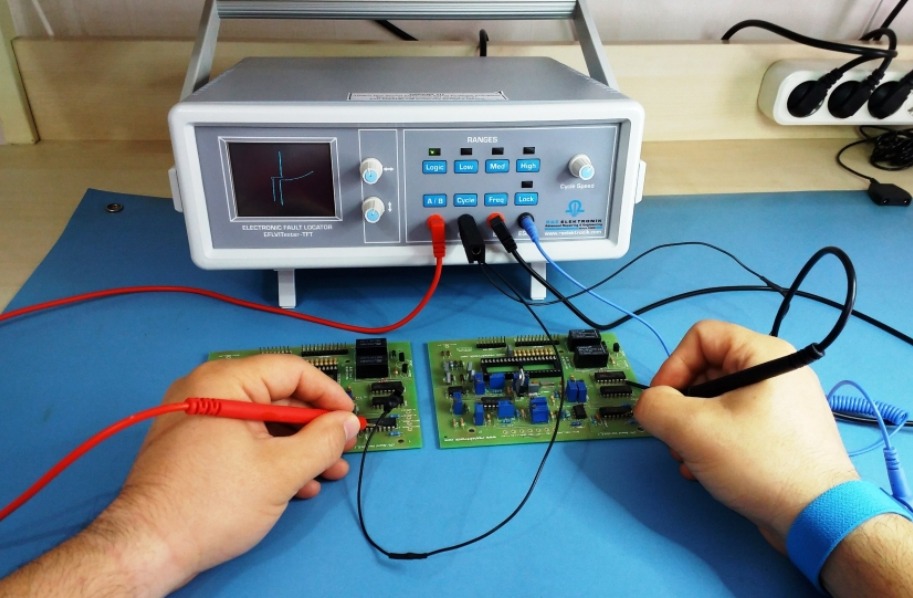
OBJECTIVE
Upon completion of this training, all participants will be able to diagnose and repair various types of electronic circuit board faults and identify system-level malfunctions.
INSTRUCTOR
Önder ŞİŞER
DURATION
12 hours
TRAINING DATES
13 – 14 June 2026
Saturday – Sunday
VENUE
Ankara Üniversitesi Sürekli Eğitim Merkezi (ANKÜSEM) Classrooms
ELIGIBILITY
Electrical and electronics technicians and technologists, senior-year students, engineers, and academicians working in the testing of electronic components are eligible to participate.
The program will commence upon reaching a sufficient number of participants.
CERTIFICATION
At the end of the 12-hour training program, participants who meet the minimum attendance requirement of 80% will be awarded a Certificate of Participation.
FEE
10,000 TL
Course Features
- Lecture 0
- Quiz 0
- Duration 12 hours
- Skill level All levels
- Students 0
- Assessments Yes
Curriculum
- 8 Sections
- 0 Lessons
- 12 Hours
- INTRODUCTION TO ELECTRONIC TROUBLESHOOTING1.1. The Importance of Fault Detection and Troubleshooting in Electronic Systems for Our Country 1.2. Overview of Electronic Troubleshooting and Testing Techniques0
- ELECTRONICS LABORATORY ENVIRONMENT2.1. What Is Antistatic Protection? Structure of an Ideal Electronics Maintenance and Repair Laboratory 2.2. Grounding in Electronics Workshops and Its Implementation0
- FUNDAMENTAL KNOWLEDGE REQUIRED FOR ELECTRONIC TROUBLESHOOTING3.1. What Is Alternating Current (AC)? 3.2. Direct Current (DC) and Its Theoretical Principles 3.3. Electronic Components in Relation to Fault Identification 3.4. Electronic Component Package Types and SMD Codes0
- ELECTRONIC CIRCUIT BOARD AND COMPONENT TEST METHODS4.1. Component Testing Method Using Impedance Characteristic Curves 4.2. Functional Testing Method 4.3. Short Circuit Fault Detection Methods 4.4. Thermal Testing Method 4.5. Boundary Scan Testing Method 4.6. Programmable Component Testing Method 4.7. Use of a Multimeter 4.8. Use of an Oscilloscope0
- ELECTRONIC COMPONENTS AND THEIR TESTING5.1. Resistors and Their Testing 5.2. Capacitors and Their Testing 5.3. Inductors and Their Testing 5.4. Diodes and Their Testing 5.5. Transistors and Their Testing 5.6. MOSFETs and Their Testing 5.7. Thyristors / TRIACs and Their Testing 5.8. Transformers and Their Testing 5.9. Relays and Their Testing 5.10. Crystal Testing 5.11. IPM / IGBT Modules and Their Testing0
- ANALOG / DIGITAL INTEGRATED CIRCUITS AND THEIR TESTING6.1. Testing of Analog Integrated Circuits 6.2. Testing of the TL084 Integrated Circuit 6.3. Voltage Regulator Integrated Circuits and Their Testing 6.4. Opto-Isolators and Their Testing 6.5. Digital Integrated Circuits 6.6. Testing Digital Integrated Circuits Using VI Curves 6.7. Programmable Integrated Circuits 6.8. Detection of Counterfeit Electronic Components0
- IDENTIFICATION OF FAULTY ELECTRONIC COMPONENTS IN ELECTRONIC SYSTEMS OR DEVICES7.1. Key Questions to Be Asked Regarding a Faulty Electronic System or Device 7.2. Isolating the Fault to the Circuit Board or Module Level 7.3. Methods for Identifying Faulty Components on an Electronic Circuit Board 7.4. Common Problems in Electronic Systems and Suggested Solutions 7.5. Preventive Maintenance and Testing Recommendations Before Device Failure Occurs 7.6. Practical Applications for Fault Identification on Electronic Circuit Boards0
- ELECTRONIC TROUBLESHOOTING AND MAINTENANCE TECHNIQUES8.1. What Is IPC and Its Mission? 8.2. Electronic Component Removal and Installation Systems 8.3. Maintenance Chemicals for Electronic Circuit Boards and Devices0